Placing me wherever I want with AI sounds easier than it is
Placing me wherever I want with AI sounds easier than it is. I wanted one picture: me, working in an office that looks like the one I actually sit in. It took two tools, two days and more than twenty generations. One of the early results was a man sitting cross-legged on top of a giant laptop.
Most posts in this series come with the exact prompts from my Claude Code history. This one cannot, and I want to be upfront about it. I searched my history for „office“, „S-Bahn“, „laptop“ and „Midjourney“, and nothing from this session is there, because Claude was not involved. The office series was made in Google’s image model (the files carry Google’s „Created by Google Generative AI“ content credentials), and that chat is gone. What I do have: the downloaded images with their timestamps and auto-generated file names, the Midjourney files, which store the full prompt in their PNG metadata, and my LinkedIn post written the same week. Everything below is reconstructed from those. Where I quote a prompt, it is a Midjourney prompt read from the file. Where I describe a step in the Google chat, I describe what changed in the image, not words I can no longer prove I typed.
Step 0: a character you can reuse
All my LinkedIn comics use the same cartoon version of me. That character started in Midjourney as a character sheet: one image with the same person in several poses. This is the prompt, read from the file (the reference photo link removed):
<reference image> character sheet of the same slim bearded man from the reference image, dark full beard, properly short cut beard, dark thick-rimmed glasses, sharp undercut haircut, good hairstyle, very thin body, narrow face, plain dark green shirt, shown in 6 poses and expressions: focused at laptop, surprised, embarrassed, proud, confused, laughing, simple clean comic style, European bande dessinée style, subtle Marvel comic energy, flat colors, clean line art, minimal background, consistent face and hairstyle, professional comic character turnaround. Guy generally having a good mood like on the real pictures. Simpler comic style with less facial details more as many lines as Simpsons characters but European marvel like. --v 7
„Properly short cut beard“, „good hairstyle“ and „very thin body“ are not style choices. Each one is there because an earlier attempt got it wrong. Character prompts grow by correction, one complaint at a time.
For the photorealistic office I needed the same trick without the comic look. So the Google session started with a realistic turnaround: front, side and back views, full body plus three head shots, black hoodie, jeans, neutral white background. That sheet became the reference for everything after it.
Attempt 1: Midjourney, the day before
I first tried it in Midjourney, with an omni reference (--oref) for my face and two style references:
<image> place the male character in an office environment sitting wearing a black sweater, clean arms, no jewelery --no watch --chaos 15 --ar 4:3 --sref <style ref 1> <style ref 2> --oref <character ref> --ow 200 --v 7
The result is technically fine. It is also a stock photo: arms crossed, big smile, an expensive glass office that could be anywhere. „Place the character in an office“ gets you the average of all offices on the internet. I could not tell Midjourney „no, the office next to the train tracks“ and have it keep everything else. Every change is a new roll of the dice, and --chaos 15 does not help with that.
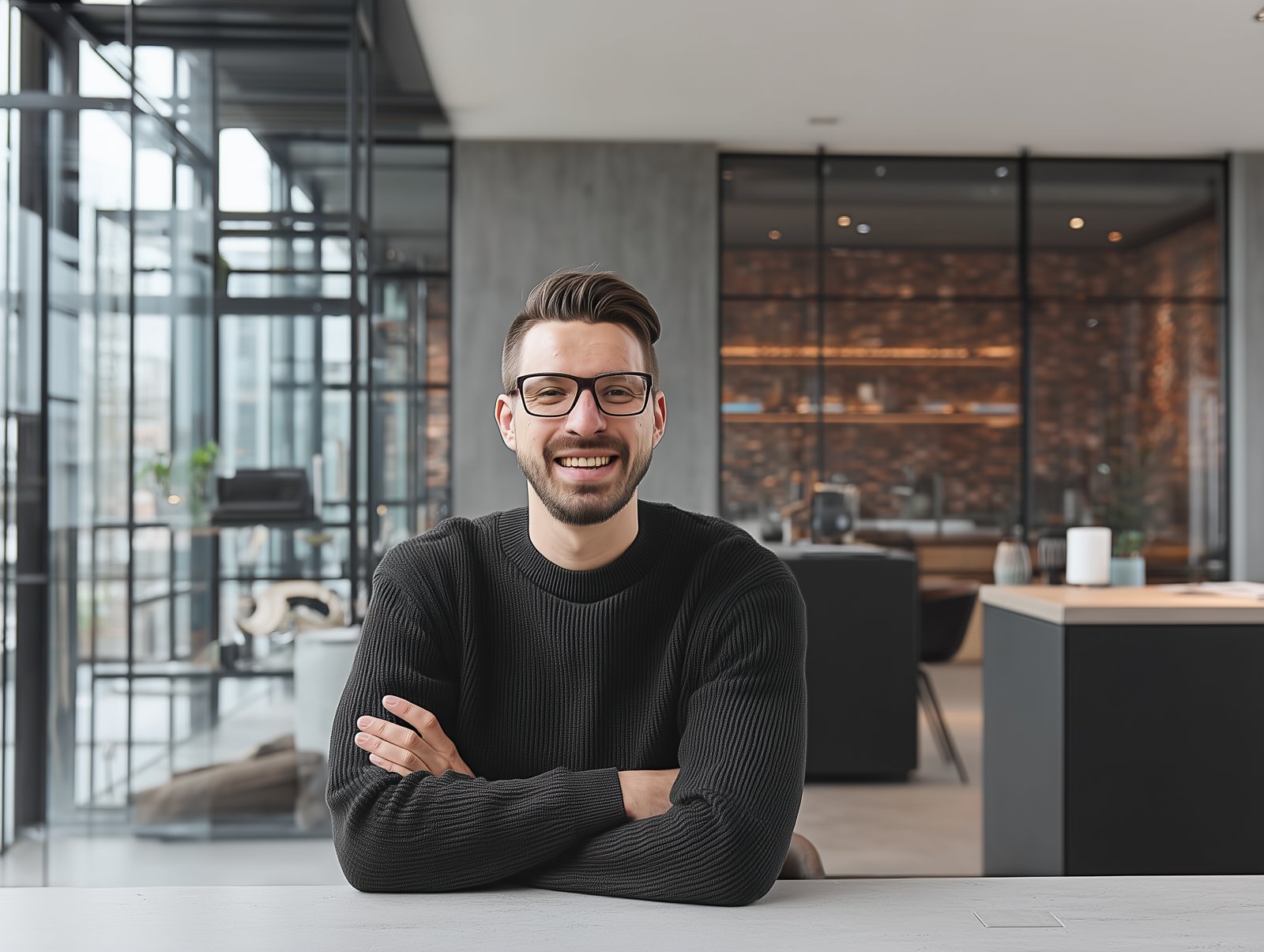 Midjourney with an omni reference: recognisably me, recognisably nowhere.
Attempt 2: a conversation instead of a prompt
The next day I switched to a chat-based image model. The difference is not image quality. The difference is that you can edit: every message changes the last picture instead of starting over. That turns image generation into the same loop I use with code. Small diff, look at the result, next diff.
The first office try in that session was too literal in its own way: a desk right next to a station platform, a long-distance train outside and a station sign in the window. Later came the moment from my LinkedIn post. I asked for the character „on a laptop“, and I got exactly that:
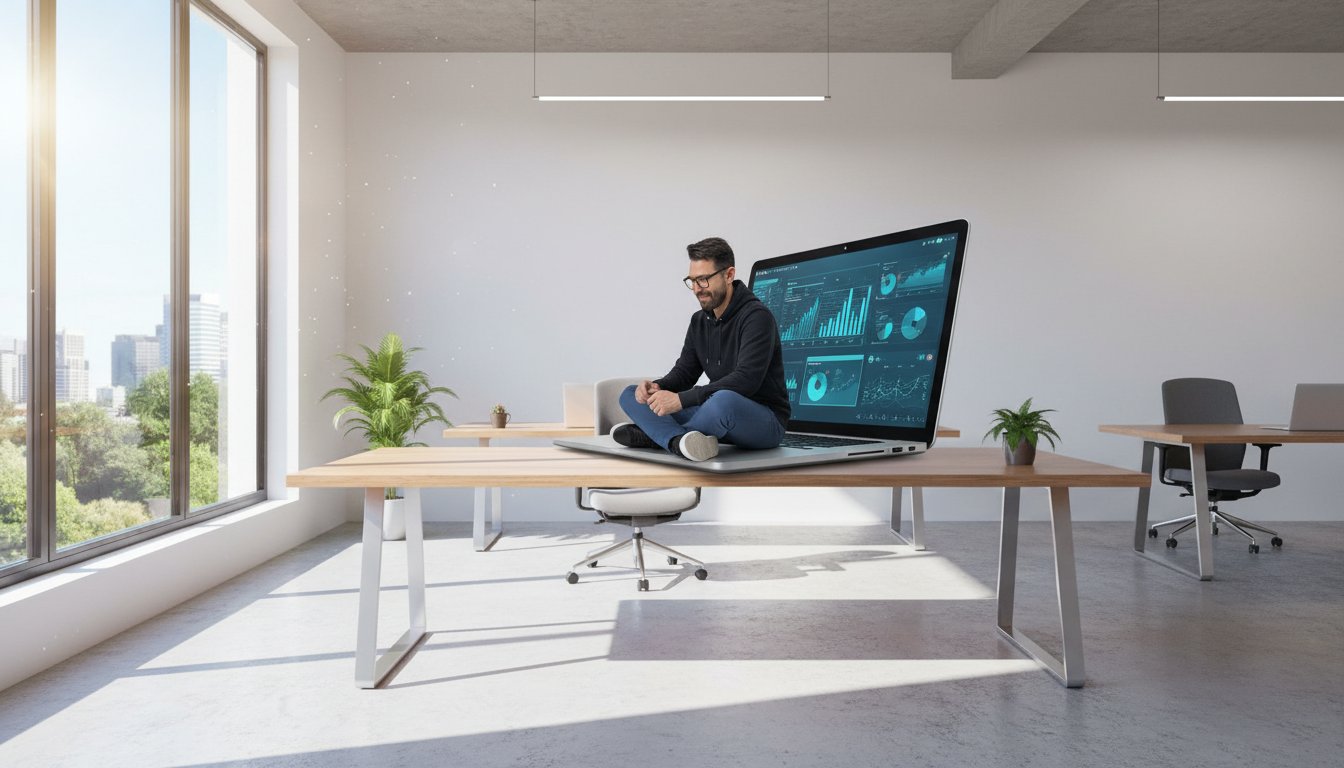 „On a laptop.“ Technically correct, the best kind of correct.
It is a good bug report. The model did not misunderstand the scene. It misunderstood one preposition. The fix was one word: at the laptop, not on it, in a modern office on a sunny day. The next image has me at a desk, backlit by big windows, sun flaring through. Correct, pleasant, and still generic.
 At the laptop, sunny day. Fixed, but it could be any office in any city.
Layering the details
From here on the file names help. The tool gives each download a short auto-generated name, and those names track the mood of the scene: character-in-office (three files), casual-office-snapshot, empty-office-snapshot (two), and then gloomy-office-snapshot, in ten variants. Once the scene turned gloomy it stayed gloomy, and every further message added detail instead of changing direction. In order, as far as the images show it:
- Glass walls and minimalist furniture. The generic office turns into a specific open space with floor-to-ceiling windows and white desks.
- The view. Not just any skyline: a German city on a grey December day. The sun disappears, the light goes flat. This is the step where the image starts to look like a real place.
- Things on the desk. Notebooks, coffee mugs, a backpack under the desk, cables.
- People and plants. Colleagues at other desks, one of them at a standing desk, big plants between the rows.
- The outside, again. 1970s apartment blocks across the tracks, and a red S-Bahn train passing by, motion blur included.
- The room itself. Desk shapes, grey carpet instead of wooden floor, and the warm orange-yellow glow of office lights against the cold daylight.
 Halfway: glass walls, white desks, a grey December city outside. Specific, but empty.
Two things surprised me. First, the lighting instruction did more than any object I added. „Gloomy December“ plus „orange-yellow artificial light“ is what makes the final image feel like 4 pm in winter, and you know that feeling if you have ever worked in a German office in December. Second, consistency is not free. If you put the ten gloomy variants side by side, the room keeps getting rebuilt: windows move, desks rotate, plants wander around. What stays stable is exactly what the text pins down: the hoodie, the laptop, the red train, the light.
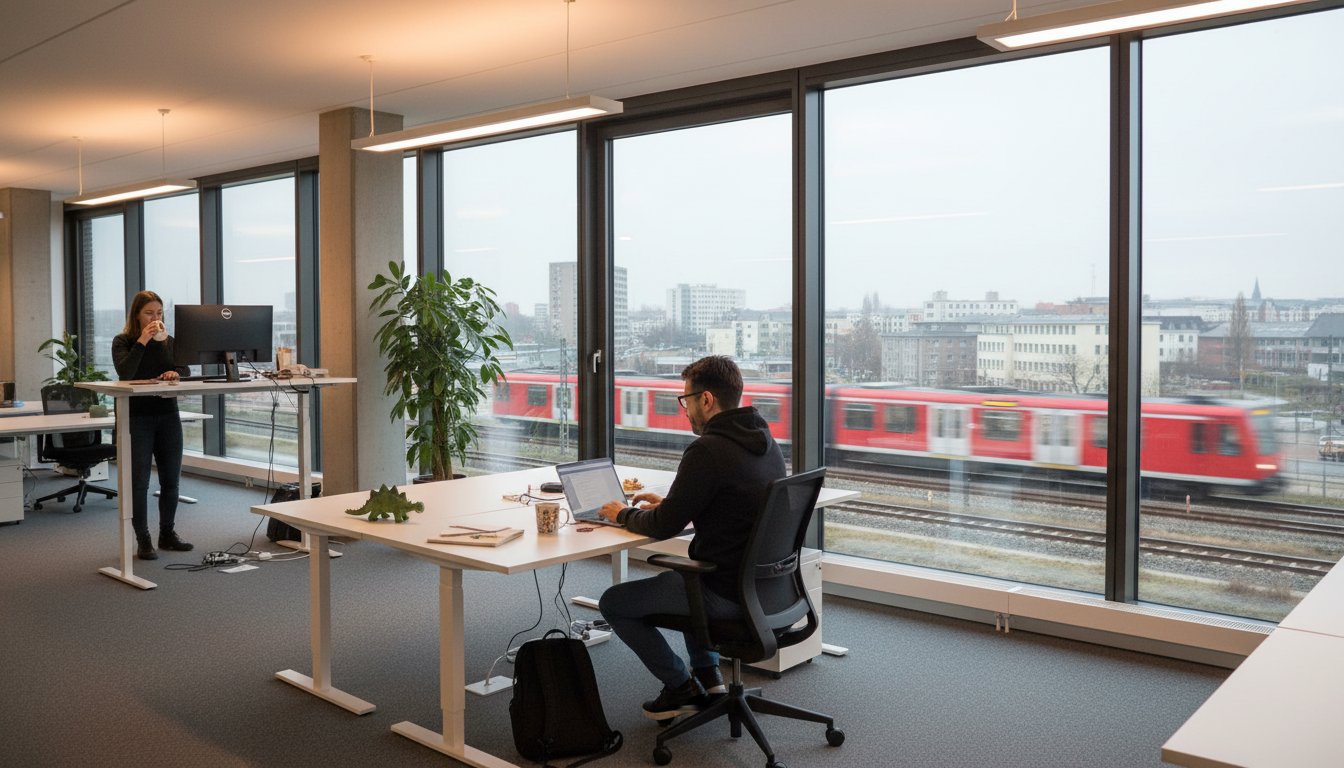 The final one: red S-Bahn, 70s blocks, standing desk, grey carpet, orange-yellow light, and a small green dinosaur nobody asked for.
What went wrong
- Prepositions. „On“ versus „at“ cost me a full generation. Image models take spatial words very literally.
- The room keeps moving. Every edit is a partial re-generation. Anything you did not name can change, so a detail you liked in version six may be gone in version seven.
- Clones. One version filled the whole office with bearded men in black hoodies and glasses. All of them me. Whether I asked for that as a joke or the model decided that all colleagues look like the reference, I honestly do not remember. With a strong character reference, „other people“ seems to be a hard concept. The file is called
clone-office-meeting.png, and I left it out of this post for everyone’s sanity. - No history. I did not keep the chat. Writing this post meant reading my own process back from file names, timestamps and metadata. Midjourney at least writes the prompt into the PNG. Next time I will save the conversation.
If you want to try it
- Start with a character sheet of yourself (front, side, back, a few head shots) and use it as the reference for everything else.
- Use a tool that edits the previous image in a conversation when you want to place yourself in a scene. Prompt-only generators are great for style and bad at „the same, but“.
- Get the subject right first, then the room, then the view, then the light. Light last, because it changes everything.
- Change one thing per message, and say what should stay the same, because whatever you do not name can change.
- Ground it in a real place. „A German city in December, 70s buildings, a red S-Bahn“ does more than „a city view“.
- Save your prompts. Future you will want to write a blog post.
The final image is not just a man in an office. It is a moment in a real-feeling place, under the flat light of an overcast German sky. The magic was not in the first prompt. It was in the twentieth message. From a weird glitch to a perfect vibe.